









Introduction to SOA OS23
To keep up with the ever-changing technological landscape, one must be open to new ideas and approaches. Now we have SOA OS23, a new service architecture that is changing the game for system design and implementation in businesses. The importance of comprehending SOA OS23 is growing as companies depend more and more on agile solutions to fulfill ever-changing market needs.
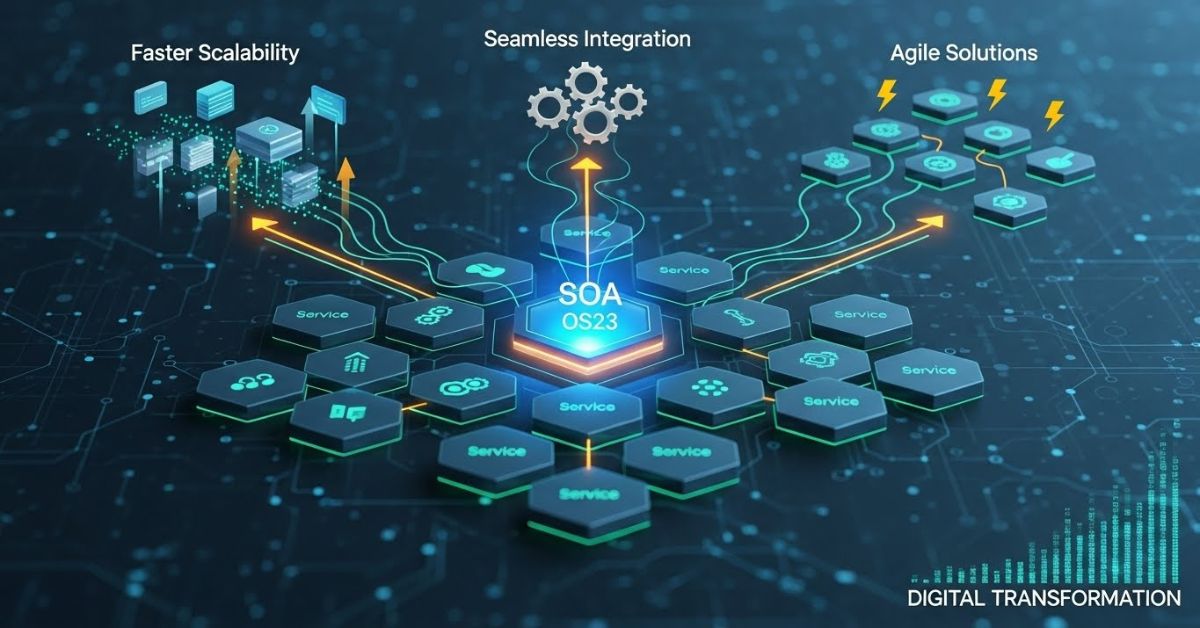
Modern businesses may take use of this state-of-the-art platform to create scalable, robust services that can change with the times. Customer satisfaction is driven by seamless interactions and operational efficiency is enhanced by SOA OS23’s integration of multiple applications into a coherent system.
Come along as we delve into the fundamentals of this revolutionary architecture and uncover the reasons why implementing SOA OS23 could be the catalyst your company needs to revolutionize its digital transformation.
What is a Service-Oriented Architecture (SOA)?
Service-Oriented Architecture (SOA) is an innovative approach to software design. It allows different services to communicate over a network. Each service performs a specific function, making it easier for organizations to create flexible systems.
This architecture promotes reusability and scalability. Developers can build applications by integrating various services rather than starting from scratch each time. This modular approach saves both time and resources.
SOA emphasizes interoperability among disparate systems. By using standard protocols, such as HTTP or SOAP, services can exchange data seamlessly regardless of the underlying technology.
Organizations that adopt SOA often find they can respond more quickly to changing business needs. As new requirements emerge, existing services can be updated or replaced without significant disruption.
Embracing SOA leads to better alignment between IT capabilities and business goals, fostering agility in today’s fast-paced digital landscape.
Benefits of Adopting SOA OS23
There are a lot of benefits for enterprises who want to improve their service architecture by adopting SOA OS23. Greater quickness is one of the main advantages. Businesses have the ability to quickly adjust to the evolving demands of the market and their customers.
Scalability is a further significant benefit. Scaling up or down services in response to workload is a breeze with SOA OS23, and it doesn’t require a complete system rewrite. Because resources are distributed more efficiently, this adaptability results in cost savings.
One notable advantage is the capacity to work with other systems. Many departments can work together more effectively since different apps and platforms can talk to each other without any hitches.
Adopting this next-gen design also encourages current services to be reused. Teams can save time and effort without sacrificing quality by reusing components from existing solutions rather than creating them from the ground up.
Organizations that adopt SOA OS23 enjoy improved overall performance as a result of these benefits.
You May Like : MataRecycler: Smart Waste Recycling Platform
Key Principles of SOA OS23
Interoperability and adaptability are at the heart of SOA OS23. Adaptability to changing business needs is prioritized in this next-gen architecture. Services allow businesses to dynamically assemble applications by providing building blocks.
Loose coupling is another important principle. Because services are self-contained, it is possible to upgrade or replace them without affecting the rest of the system. Because of this, innovation flourishes and upgrade downtime is minimized.
In SOA OS23, standardized protocols for communication are crucial. The use of standard formats such as JSON or XML allows services to communicate without any hitches across various platforms.
The importance of discoverability is crucial. Developers should be able to swiftly discover and reuse existing functionality by making services simply locatable within an organization’s ecosystem. As a result, teams working on software development initiatives are more likely to work together and provide better results.
Implementing SOA OS23 in Your Organization
A customized strategy is necessary for your organization’s implementation of SOA OS23. In order to find integration opportunities and gaps, you should first evaluate your current architecture.
Involve stakeholders from the beginning. Their feedback is priceless for identifying unique requirements and possible obstacles. Form interdisciplinary teams with members from different divisions.
The next step is to make an investment in staff training. Being familiar with the principles of service orientation architecture (SOA) will facilitate the changeover and encourage teamwork.
It is important to select tools that are compatible with the SOA OS23 requirements. On top of guaranteeing scalability, modern platforms can improve performance.
Start implementing things slowly. In order to test ideas without affecting current operations, pilot programs are a great way to proceed. In order to improve procedures as you go towards full adoption, it is important to regularly gather input.
At this stage, adaptability is crucial; be ready to change tactics depending on what happens in the real world and the difficulties you encounter.
Case Studies: Successful Implementation of SOA OS23
An international e-commerce behemoth is one of the most prominent instances of SOA OS23 deployment. They increased the responsiveness of their system by switching to this architecture. In response to shifting consumer tastes and market conditions, the company wasted no time inadjusting.
A multinational bank has another success story. They used SOA OS23 to combine different banking services without any hitches. Both operational costs and customer experiences were improved as a result of this integration.
An industry-leading healthcare facility improved departmental data sharing with the help of SOA OS23. Showing how effective service-oriented systems can be, this initiative led to quicker patient care and more precise diagnosis.
The automotive manufacturer’s supply chain management was improved with the use of SOA OS23. They greatly increased productivity while decreasing waste by standardizing procedures and facilitating cross-platform data access in real time.
Challenges and Solutions for Adopting SOA OS23
Several obstacles may arise during the adoption of SOA OS23. The incorporation of existing systems is a big challenge. The older technology that many firms use isn’t compatible with the more modern service-oriented designs.
The areas of management and governance also provide difficulties. Important but sometimes disregarded is the need to set clear policies for the development and upkeep of services. Teams run the risk of duplicating efforts or reinventing the wheel in the absence of clear rules.
Another major obstacle is the lack of necessary skills. Implementation attempts could be hindered if employees do not possess sufficient experience with SOA principles. One way to effectively close this gap is to invest in training programs.
Those who are resistant to change often slow down development. People with vested interests in maintaining status quo approaches may be reluctant to change. Fostering acceptance and promoting faster transitions across departments is achieved through encouraging open communication on the benefits of SOA OS23.
Future of Service-Oriented Architecture – Emerging Trends and Predictions
A revolutionary change in how businesses handle integration and service delivery is on the horizon for Service-Oriented Architecture (SOA), particularly with the release of SOA OS23. Microservices are becoming an integral aspect of company architecture strategies. Both scalability and flexibility are improved by this trend.
The emergence of AI-driven services is another significant change. Decisions may be made with more intelligence when AI is integrated into SOA. Organizations are able to improve their overall efficiency by responding quickly to changes.
In this dynamic environment, safety is of the utmost importance. As more advanced methods for data protection inside service-oriented frameworks are used by enterprises, enhanced security protocols will eventually become the norm.
More and more, cloud computing and service-oriented architecture are working together. To optimize performance and guarantee seamless interoperability across platforms, enterprises must leverage SOA OS23 as they move more workloads to the cloud.
Conclusion
To survive and prosper in today’s rapidly changing technological landscape, enterprises must be nimble. When it comes to efficient, scalable, and agile service delivery, SOA OS23 is head and shoulders above the competition. Businesses can take advantage of modular services that interface smoothly with existing systems by adopting this next-generation design.
There is a clear uptick in the advantages of SOA OS23 as its adoption rates rise. Creative solutions that are adapted to the ever-changing demands of the market are the result of improved cross-departmental collaboration. Organizations are certain to not only stay up-to-date, but also to establish new benchmarks in service design by adhering to the concepts outlined in SOA OS23.
Implementation isn’t always smooth, but when things become tough, that’s when teams learn and improve. Companies can successfully overcome challenges with the use of real-world examples and well-defined plans for moving to SOA OS23.
Organizations will continue to have their architecture deployments influenced by developing trends in the future. To keep up with the competition in a dynamic market, it’s important to monitor these trends.
To future-proof your business against unpredictability and promote creativity at every level, adopting SOA OS23 is more than just a decision; it’s a strategic action. Take advantage of this chance now to make your business a success.
Read More : serlig — Redefining Authenticity in 2025